Thomas Nimstad: Crash Was the Spark — Multiplayer Is the Fire Driving iGaming Forward

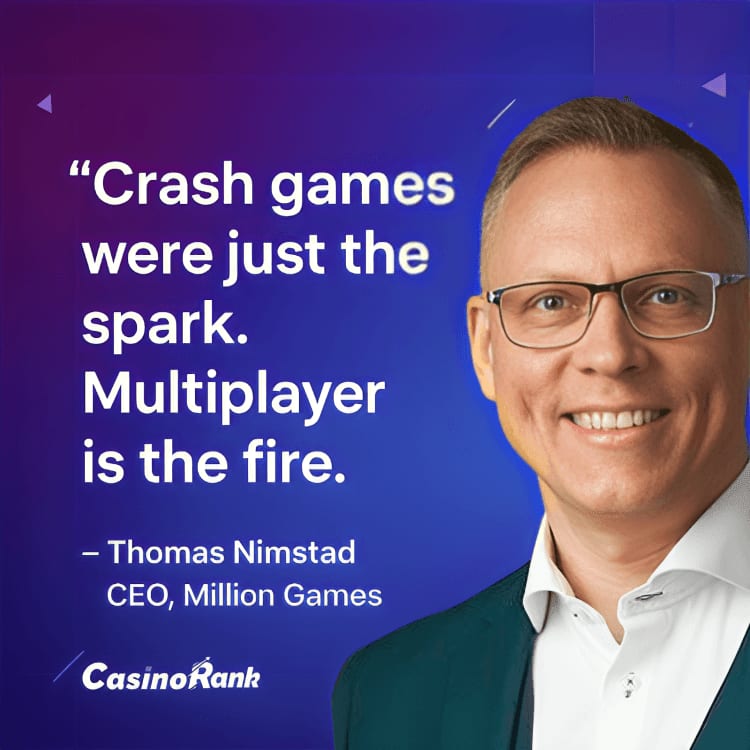
Thomas Nimstad, CEO of Million Games, believes crash games were just the beginning. In this CasinoRank interview, he explains why multiplayer formats are igniting the next wave of iGaming innovation.
From embedding compliance into creativity to weaving responsible gaming into design, Nimstad outlines how Million Games balances slots, crash, and unique card titles with socially driven play. With hit releases like Chicken X and the Million Stars partner program, he shares a vision for iGaming where data, collaboration, and player-first experiences define the future.
Crash and multiplayer games are becoming a dominant trend in iGaming. What do you think is driving their popularity, and how do you see this evolving in the next few years?
Thomas Nimstad: Crash and multiplayer games tap into something deeply social and immediate. Today’s players—especially younger audiences—want fast-paced entertainment with a competitive edge. These games create shared experiences where timing, risk, and social dynamics come together in real time. That creates a very different emotion compared to spinning a traditional slot.
We see these games as part of a broader offer, one that includes active play for players who want to feel more in control, more engaged, and more connected. Multi-player formats deliver that by combining game mechanics with a community vibe.
At Million Games, we believe the future lies in blended formats—games that merge the familiarity of casino mechanics with the energy of social and skill-based play. Expect more games that feel alive, where you’re not just playing against the house, but alongside or against other players, but also more crash titles.
Crash was the beginning. Multiplayer is the expansion pack. But let’s not forget the bread-and-butter of any casino offering—slots, instant games and classic table games. These games continue to drive revenue and player loyalty. It’s not about one trend replacing another—it’s about building a balanced, modern portfolio that delivers a game for every kind of player.
With regulations tightening in many markets, how does Million Games approach compliance while maintaining creativity and engaging game design?
Thomas Nimstad: We see regulation not as a restriction, but as a creative framework. At Million Games, compliance is baked into the development process from day one—not tacked on at the end. We work closely with partners to ensure each game meets the requirements of the target markets without compromising on fun.
Creative design doesn’t mean ignoring the rules—it means working smart within them. Whether it’s adjusting RTP ranges, simplifying bonus mechanics, or designing features that scale to local regulations, we find ways to deliver exciting gameplay that ticks all the boxes.
The key is collaboration. Our designers, developers, compliance experts, and QA teams work side by side to build games that are not only beautiful and engaging, but also audit-ready and adaptable. It’s this cross-functional approach that lets us stay agile as we grow into more regulated markets.
In fact, some of our most popular titles—like Chicken X and Plinko—were built with highly regulated markets in mind. It proves you can be compliant and still make games people love to play.
Responsible gaming is now a key focus in the industry. How do you integrate safe gaming practices into your products without compromising on entertainment?
Thomas Nimstad: We believe that entertainment and responsibility are not opposing forces—they go hand in hand. We have integrated responsible gaming features at the platform level, ensuring our games are fully compatible with operators tools for session limits, reality checks, and self-exclusion systems. These tools are essential for long-term sustainability in iGaming.
More importantly, we design with player well-being in mind from the start. That means clear game rules, transparent RTP information, and game mechanics that are engaging—but not manipulative. We avoid dark patterns and instead focus on delivering fair, enjoyable experiences that players can dip into and out of at their own pace.
Entertainment is at the heart of what we do—but it should never come at the expense of control or safety. Responsible gaming isn’t just a box we tick; it’s part of how we earn long-term trust.
Million Games offers slots, crash games, and unique card games like Draw Sevens™. How does this diversity fit into your overall strategy for standing out in a competitive market?
Thomas Nimstad: For us, it’s all about striking the right balance between innovation and familiarity. We believe players return to games that feel intuitive and rewarding, but they stay for the moments that surprise and entertain them. That’s why we mix bread-and-butter formats—like slots and classic card games—with fresh mechanics and unexpected twists.
Whether it’s a high-stakes highway dash in Chicken X, the serene duality of Yin & Yang, or the simple yet strategic thrill of Draw SevensTM, each title is built around one core principle: put the player first. We design entertainment experiences that are easy to pick up, fun to explore, and exciting enough to spark repeat play.
This variety also gives us agility. It allows us to respond quickly to shifting market trends while still anchoring our roadmap in proven concepts that work. By blending accessibility with innovation and excitement, we aim to deliver games that not only entertain, but consistently perform for our partners.
You have the Million Stars partner program that enables collaborations. How important are partnerships for scaling innovation in today’s iGaming landscape?
Thomas Nimstad: Partnerships are absolutely essential—especially for new studios trying to break through. The reality is, many talented game creators struggle to reach operators and aggregators simply because their portfolio isn’t big enough to justify an integration on its own. That’s one of the challenges we set out to solve with the Million Stars partner program.
Million Stars gives smaller studios an RGS platform to shine and create on without all the technical hassles. It allows us to combine multiple studio’s games under one trusted framework—making it easier for partners to access diverse, innovative content through a single integration. It’s a win-win. Studios get visibility and distribution, while operators get a stream of high-quality, curated games without the integration overhead.
But it’s more than a distribution model—it’s a creative ecosystem. We inspire each other, we share best practices, and we grow together. That collaborative spirit fuels innovation, and it’s something we’re incredibly proud to foster.
What role does player data or analytics play in shaping your roadmap and game development priorities?
Thomas Nimstad: Player data is absolutely central to how we plan, build, and optimise. While trends come and go, the core driver behind any game’s success is still entertainment—and the possibility of a big win. Analytics help us understand how players engage with different game types, features, and formats across diverse markets and demographics.
Because Million Games targets multiple regions and player segments, our roadmap must be grounded by real behaviour—not a guessing game. Data shows us what resonates where. Maybe a particular game mechanic performs exceptionally well in one region, while another title sees better retention in a different market. These insights let us adapt game design, prioritise features, and tailor our creative approach.
Beyond development, this intelligence also feeds into our commercial strategy. We use it to fine-tune discussions with operators, align on market-specific campaigns, and understand what kind of content different players are truly looking for—right down to preferred themes, currencies, and volatility ranges.
In short: data tells us what works. Then we build more of it.
Chicken X, your crash title, earned a MiGEA nomination. What was the biggest creative or technical challenge in delivering a crash game with an arcade twist?
Thomas Nimstad: Chicken X started as a passion project—one of those rare ideas that just sparks genuine excitement across the whole team. We knew we wanted to create a crash game, but we also wanted it to feel different. That’s where the arcade inspiration came in: fast reflexes, quirky animations, and a big dose of personality.
One of the biggest creative challenges was striking the right tone. Crash games are usually minimalistic—Chicken X went the opposite route. We let our graphic designer lead the vision, leaning heavily into playful visuals and humour. Marrying that with the timing precision and responsiveness required in crash mechanics took close collaboration between design and development.
Sometimes you can’t predict which game will break through. You just have to build something you believe in—and have fun doing it. That’s exactly what Chicken X became for us. From concept to playtesting, it was a joy to create. The MiGEA nomination was the icing on the cake.
Social interaction and gamification are reshaping player engagement. Is Million Games planning features like tournaments, community-driven play, or multiplayer modes?
Thomas Nimstad: Absolutely—and it’s already underway. We’ve developed multiplayer titles like Million Wheel, which represent just the beginning of our journey into more socially driven gameplay. Our platform is built with this in mind and already supports tournaments, free bets, feature bets, and burst mode—ideal for creating energy around high-volume, high-action games.
When it comes to community-driven experiences, we see a strong opportunity in partnering with aggregators and operators to bring these to life. We provide the tools and game mechanics; they bring the audience and marketing power. From time-limited tournaments to themed campaigns, the flexibility is there—and we’re excited to collaborate on more of these initiatives.
Our goal is to design games that not only entertain, but also connect. Whether it’s leaderboard-driven events or real-time multiplayer, we believe the future of iGaming includes shared moments—not just solo spins.
Looking ahead, what technologies or trends—such as AI personalization, AR/VR integration, or cross-platform gaming—do you see having the biggest impact on iGaming?
Thomas Nimstad: AI-powered personalisation will likely have the biggest short-term impact across the board. Players now expect tailored experiences—from the games they see first, to how bonuses are presented, to the pacing of gameplay. As data and machine learning become more accessible, operators and studios alike will be able to fine-tune the player journey in real time. For game developers like us, this means designing games that can adapt to different audiences through dynamic features, volatility levels, and in-game rewards.
Cross-platform gaming is another major factor, particularly as mobile continues to dominate. Seamless transitions between devices, instant play, and lightweight game performance will be vital for keeping players engaged—especially in emerging markets.
As for AR and VR, we’re keeping a close eye. The technology is exciting but still finding its footing in real-money gaming. We’re more focused on building socially engaging, multiplayer-friendly content that feels immersive—without requiring a headset. We believe the real future lies in blending innovation with accessibility. Technology should enhance the experience—not complicate it.
At Million Games, we’re not chasing gimmicks—we’re building entertainment experiences that players genuinely enjoy. Whether it’s a comfort food slot, a high-energy crash game, a unique card title like Draw Sevens™, or a socially driven multiplayer release, every title we create is shaped by real insights, strong partnerships, and a commitment to accessible innovation. From crash to classic, from solo play to shared moments, we design games that entertain—because that’s what keeps players coming back. We’re excited about where the industry is heading—and even more excited to help shape it.