Jonathan Gauci: The Architecture Behind Scalable, Market-Ready Gaming Platforms

Jonathan Gauci, Co-Founder of Elantil, defines a platform philosophy centered on adaptability and precision. In markets where player behaviors, regulatory frameworks, and operational expectations differ significantly, platform design must balance flexibility with structural consistency.
Gauci describes how Elantil’s modular architecture provides operators with the capability to configure, localize, and differentiate across jurisdictions without compromising compliance or scalability.
This approach positions technology as a strategic backbone—supporting tailored market entry, regulatory alignment, and sustainable global growth.
Different regions often show unique player preferences and regulatory requirements. How do these variations influence the way platforms are designed and operated?
Jonathan Gauci: Different regions show unique player behaviors, customer journeys, and regulatory demands. Many platforms are engineered to excel in a single region or product philosophy, which forces operators to adapt their business to the technology, not the other way around.
Elantil takes a fundamentally different stance. We don’t dictate what the “ideal”customer experience or risk posture should be in a given market. Instead, we provide a robust, modular strategic backbone and an extensive toolset that allows operators to configure, localize, and differentiate with precision.
Whether entering a highly regulated European market or a fast-moving Crypto environment, operators can tailor workflows, controls, and player journeys to their own vision, while retaining a single, unified technology stack that scales globally.
With regulations evolving rapidly, what do you see as the biggest challenges for platform providers in balancing compliance with flexibility for operators?
Jonathan Gauci: One of the biggest challenges is that too many platforms interpret compliance as a user experience. They take regulatory text and translate it directly into screens as rigid flows, forced friction, and zero imagination. But compliance is not the product. The product should be a fun, safe entertainment experience that
happens to be compliant.
There’s a widening gap between people who truly understand player enjoyment, those who have operated casinos and lived the product, and those who only see it as a checklist in a spreadsheet. Our view is that the right technology should enable innovation within regulated boundaries: delivering strong player protection without sacrificing excitement, fluidity, and trust. Compliance should be the safety net, not the ceiling.
Operators increasingly want control over their own data and hosting. From your perspective, how is this trend shaping the way platforms are built and maintanied?
Jonathan Gauci: It’s a natural evolution — data drives differentiation, and infrastructure sovereignty supports regulatory alignment and cost control. But achieving this isn’t simple. Running a high-throughput iGaming platform efficiently requires deep technical maturity. The advances in DevOps over the past decade, such as container orchestration, infrastructure-as-code, and automated observability, have made self-hosting possible, but only a few providers have mastered the art of intensive design with minimal operational burden.
At Elantil, we architected from day one for operator autonomy. The platform is portable, cloud-agnostic, and optimised for low-maintenance operation at scale. Operators retain data control and deployment freedom, while we provide the strategic backbone and tooling that keep the environment fast, secure, compliant, and resilient.
Elantil has recently integrated content from providers like Thunderkick, Pateplay, and Yggdrasil. How do such partnerships help platforms meet regional player expectations without being tied to a single market?
Jonathan Gauci: Meeting regional expectations isn’t just about having content; it’s about having the right content in the right moment. Players gravitate toward what they already know and trust, often influenced by their local retail casino experience. But they
also want novelty and surprise. To capture that nuanced player mood dynamically, you need a broad and diverse catalogue that recommendation engines can actively rotate and personalize against.
That’s why hitting our 50th casino provider integration in just one year is such an important milestone. It gives operators the depth required for true experiential agility, where familiarity, innovation, and real-time personalisation coexist seamlessly.
With Elantil, operators can continuously tune their offering to what each player wants right now, not just what the generic market wanted last year.
Casino and sportsbook offerings are increasingly converging. How do you see this trend influencing the design and delivery of platform services?
Jonathan Gauci: I see convergence happening because the digital-native generation has become the dominant customer base. The industry is reacting, often as a knee-jerk response, to their expectations.
These players grew up with platforms like Fortnite and TikTok, where content is constantly refreshed, seasons shift rapidly, and the experience evolves week by week. They are conditioned for fast interaction, continuous novelty, and seamless transitions between different types of entertainment.
So operators try to inject more products into a single journey to maintain that dopamine-driven engagement. But the approach isn’t always right. A new wave of industry movers coming from the crypto and Web3 world values time on product and community-led experiences over micro-monetisation per click. Convergence shouldn’t just cram products together — it should create richer, more dynamic entertainment loops.
The launch of Goatz.com on Elantil highlighted the platform’s ability to support rapid, multi-market rollouts. What were the biggest lessons from that launch?
Jonathan Gauci: The launch of Goatz.com taught us that delivering cutting-edge technology is only part of the equation. It was a rocky start — fast timelines, ambitious goals, and constant iteration. But by leaning in together, it evolved into a genuine partnership and even a friendship.
The real success came from aligning technology with vision: helping refine ideas, making tough prioritisation calls, and ensuring the rollout was both efficient today and scalable for tomorrow.
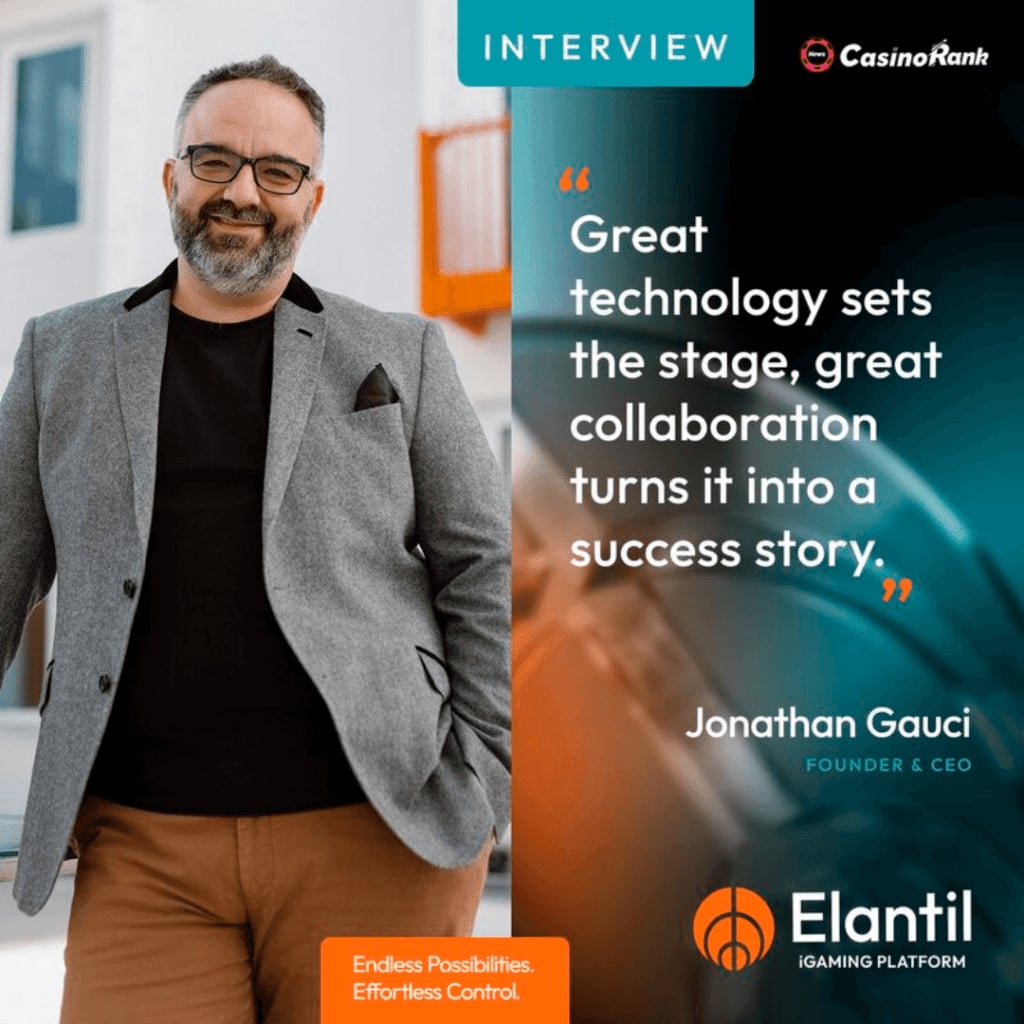
We learned that communication, co-ownership, and trust matter just as much as architecture and performance. When our expertise combines with a client’s passion, the result is far greater than the platform alone. Great technology sets the stage, great collaboration turns it into a success story.
Looking ahead, which developments—whether in technology, content, or market trends—are you most excited about in the platform space?
Jonathan Gauci: What excites me most is the natural convergence of iGaming into the broader entertainment industry. We’ve touched on it earlier, but the real breakthrough will come when our strengths in high-throughput, highly-regulated, revenue-generating technology intersect with the storytelling and immersion of video games and even financial trading experiences like forex.
Our industry knows better than anyone how to deliver maximum entertainment value per second of engagement. Where others struggle to monetise, iGaming has already mastered the sweet spot. I believe we’ll not far away from seeing traditional game studios and iGaming companies join forces, creating entirely new entertainment formats. And the platforms we’re building today — modular, scalable, and agile — will be the backbone powering that shift.