Konstantins Vasilenko, Paybis: The Infrastructure Behind Everyday Crypto Payments

Konstantins Vasilenko is Co-founder of Paybis, where he oversees the company’s evolution from a consumer crypto platform into global crypto↔fiat infrastructure serving 250+ partners across 180+ countries. The timing reflects a clear market shift: Paybis data shows stablecoins grew from 12% of platform volume in 2023 to 86% by April 2026, and during the first four months of that year, nearly 98% of stablecoin volume came from B2B use cases like cross-border settlement and treasury operations.
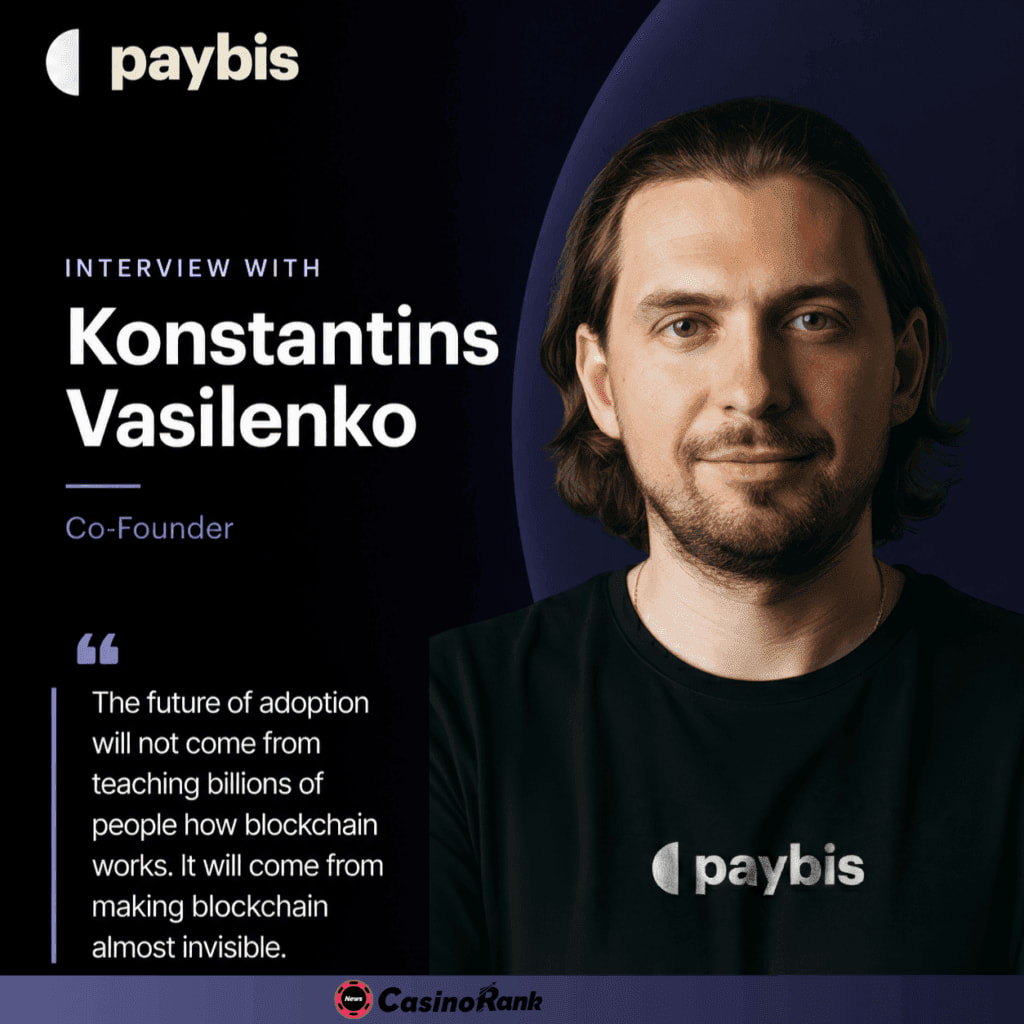
In this CasinoRank interview, Vasilenko discusses why businesses are adopting stablecoins for real operational needs rather than speculation, where crypto onboarding still loses users, and why speed, transparency, and predictability now define customer trust. He also explains why the next wave of adoption won’t come from teaching people blockchain, but from financial products making the technology invisible.
Paybis has grown from a consumer crypto platform into a global crypto↔fiat infrastructure provider. Where do businesses and everyday users still have very different expectations when it comes to crypto payments and accessibility?
Konstantins Vasilenko: The biggest difference is that consumers and businesses are solving fundamentally different problems.
Consumers care about convenience. They want to move money quickly, access crypto through familiar payment methods, and complete transactions without having to understand how blockchain infrastructure works. They judge the experience based on simplicity and trust.
Businesses focus on efficiency. Their priorities are settlement speed, operational costs, treasury management, liquidity, and compliance. They are not looking for exposure to crypto. They are looking for better financial infrastructure.
What’s interesting is that these two worlds are starting to converge around payments. The strongest example is stablecoins. On Paybis, stablecoins accounted for just 12% of crypto volume in July 2023. By April 2026, that figure had reached 86%. This tells us the conversation is moving away from speculation and toward practical financial use cases. Businesses increasingly see stablecoins as a settlement layer, while consumers increasingly expect crypto services to work as seamlessly as any fintech app.
Ultimately, both groups want the same thing: faster, more transparent movement of money. They simply approach the problem from different directions.
Crypto onboarding is still a major challenge for many platforms. Even with simpler KYC and fiat↔crypto flows, where are businesses still losing users during the signup and payment process?
Konstantins Vasilenko: The industry often focuses on reducing friction during onboarding, but many users are lost before onboarding even starts.
Customers abandon the process when they encounter uncertainty. They may not understand why verification is required, which payment method to choose, or whether a transaction will be completed successfully. Every unanswered question increases drop-off.
Another challenge is fragmentation. A user starts on one platform, completes verification somewhere else, returns to finalize a payment, and then needs to interact with a separate wallet provider. Every additional step creates friction.
We also see that businesses sometimes expose customers to crypto-specific concepts that are irrelevant to the end goal. Most users don’t want to think about networks, wallet types, or blockchain architecture. They simply want to complete a transaction.
The most successful onboarding experiences are those where the underlying infrastructure becomes almost invisible. Crypto adoption grows when users focus on the outcome rather than the technology.
Stablecoins are increasingly being used for payments instead of just trading. What signs are you seeing that users are starting to trust stablecoins for everyday transactions and transfers?
Konstantins Vasilenko: The strongest signal is that stablecoin activity is increasingly being driven by real economic activity rather than trading.
Our latest research shows that stablecoins represented 86% of Paybis crypto volume in April 2026, compared with just 12% in July 2023. More importantly, nearly 98% of stablecoin volume processed through our platform during the first four months of 2026 came from B2B use cases.
That shift is significant because businesses typically adopt new payment infrastructure only when it delivers measurable advantages. We’re seeing stablecoins used for cross-border settlements, supplier payments, treasury operations, and international payouts.
Our survey of business decision-makers also found that 22.5% of companies already use stablecoins for cross-border payments or plan to do so within the next 12 months. That’s a remarkable number considering how early this market still is.
What’s happening now is similar to the early days of cloud computing. Users are not adopting stablecoins because they are interested in blockchain. They are adopting them because they solve real operational problems. When a business can settle internationally within minutes instead of days and often at a fraction of traditional costs, trust develops naturally through repeated use.
Paybis supports both crypto payouts and fiat settlement across global markets. From a customer perspective, what payment experiences now matter most when it comes to building trust and retention?
Konstantins Vasilenko: Customers increasingly expect three things: speed, transparency, and predictability.
Speed is important, but transparency is often even more valuable. Users want to know exactly where their money is, what fees they are paying, and when settlement will occur.
Predictability is equally critical. Customers don’t want to wonder whether a transaction will be delayed because of banking hours, intermediaries, or regional payment restrictions.
One interesting finding from our recent research is that many businesses still underestimate how quickly stablecoin payments settle and overestimate their cost. Nearly half of surveyed respondents expected international stablecoin transfers to take between one hour and one day, while many expected fees around 3%, even though actual settlement often occurs within minutes and costs are frequently below 1%.
That gap highlights an important reality: trust is not built only through technology. It is built through consistent user experiences and clear communication.
Many operators and fintech companies now want to add crypto services to their platforms. Where do businesses still overcomplicate the user experience when introducing crypto payments or wallets?
Konstantins Vasilenko: A common mistake is building products for crypto enthusiasts instead of mainstream users.
Many companies still introduce concepts such as wallet management, blockchain networks, private keys, and token standards far too early in the customer journey. For most users, those concepts are implementation details, not features.
The reality is simple: customers want to send money, receive money, store value, or make payments. They are not looking to become blockchain experts.
The most successful fintech and payment companies are treating crypto as infrastructure rather than a destination. The technology should stay in the background while the customer focuses on the outcome.
The future of adoption will not come from teaching billions of people how blockchain works. It will come from making blockchain almost invisible.
Compliance checks are becoming stricter, but users still expect fast onboarding and instant transactions. How is Paybis balancing stronger AML requirements with the demand for a smoother customer experience?
Konstantins Vasilenko: Compliance and user experience are often presented as competing priorities, but in reality they reinforce each other.
Trust is impossible without strong compliance. At the same time, compliance should not create unnecessary friction for legitimate customers.
Our approach is to make compliance more intelligent rather than more intrusive. Advances in automated verification, transaction monitoring, behavioral analysis, and risk scoring allow us to maintain strong AML standards while keeping onboarding efficient.
The key is proportionality. Not every customer presents the same level of risk, and not every transaction requires the same level of scrutiny.
As the industry matures and regulatory frameworks such as MiCA create greater clarity, we believe businesses will increasingly view compliance not as a barrier to growth, but as a competitive advantage.
Looking ahead, where does the company see the biggest opportunity for bringing crypto services into everyday financial activity, especially for users and businesses that still don’t consider themselves “crypto-native”?
Konstantins Vasilenko: The biggest opportunity is embedded financial infrastructure powered by crypto rails.
Most future users will never wake up and decide to become crypto-native. They will use products that solve financial problems more efficiently, and crypto will simply be part of the underlying infrastructure.
We’re already seeing this transition happen through stablecoin-powered cross-border payments, treasury operations, global payouts, and settlement services.
The market data supports this direction. Stablecoin payment volumes globally continue to grow rapidly, while major financial institutions, payment companies, and fintech platforms are actively integrating stablecoin infrastructure into their products.
The next wave of adoption will not come from crypto companies convincing people to enter crypto. It will come from financial products quietly integrating crypto capabilities behind the scenes.
When that happens, users will stop asking whether a transaction runs on traditional rails or blockchain rails. They will simply expect money to move instantly, transparently, and globally.